
A warehouse racking system is only as reliable as the timber sitting on its beams. While your steel structure might be rated for heavy loads, a single faulty pallet can trigger a catastrophic collapse that puts your team and your inventory at risk. If you’re looking to source second hand racking pallets that Australian businesses can trust, you’ve likely felt the tension between wanting to reduce procurement costs and the absolute necessity of meeting Australian safety standards.
We understand that navigating AS 4084:2023 compliance while managing a tight logistics budget isn’t always straightforward. It’s a high-stakes environment where dependability is everything. This guide helps you bridge the gap between affordability and operational safety by showing you exactly how to identify high-quality refurbished stock. You’ll learn how to source reliable 2-tonne racking pallets and establish a clear inspection framework for your facility. We’ll provide the clarity you need to maintain a compliant, cost-effective warehouse centre while ensuring every load remains secure and every staff member stays safe.
Key Takeaways
- Learn why “pallet deflection” is a leading cause of warehouse accidents and how to choose timber engineered to span beams safely.
- Discover the specific construction requirements for racking-grade pallets, including the essential board thickness needed to withstand constant beam pressure.
- Identify the most cost-effective way to source second hand racking pallets Perth facilities require for high-density storage without compromising on AS 4084:2023 compliance.
- Compare 1-tonne and 2-tonne pallet types to ensure you are matching the right load capacity to your specific industrial racking configuration.
- Master a simple inspection framework to spot hidden structural fatigue and learn how professional collection services can help you maintain a safe, high-quality inventory.
The Critical Role of Safe Racking Pallets in Modern Logistics
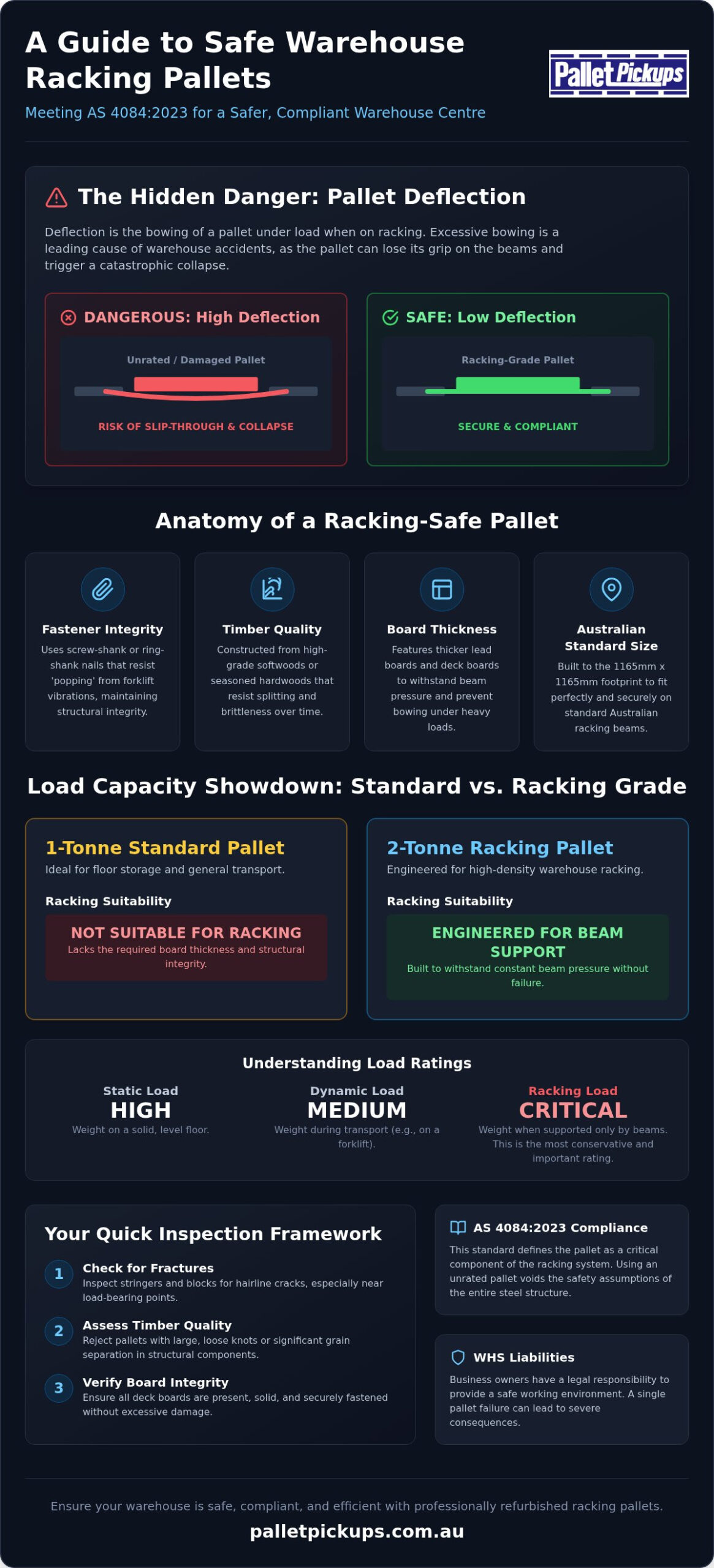
A racking-safe pallet is specifically engineered to span across storage beams without excessive deflection. In a warehouse environment, deflection refers to the vertical distance a pallet bows when under load. If a pallet bows too far, it loses its structural grip on the steel beams and can slip through the gap. This is why “standard-sized” units aren’t always interchangeable. While a light-duty pallet might look identical to a heavy-duty one, it often lacks the internal board thickness required to remain rigid while suspended. For those sourcing second hand racking pallets Perth operators rely on, verifying this structural integrity is the first step toward a safe facility.
The Australian Standard AS 4084.2:2023 provides the definitive framework for warehouse storage operation and maintenance. It highlights that the pallet is a critical component of the racking system itself. Using an unrated or damaged pallet effectively voids the safety assumptions of the entire steel structure. Consistency in your pallet inventory is not just a matter of convenience; it’s a fundamental safety requirement that protects your infrastructure and your people.
Understanding Static vs. Racking Load Capacity
It’s vital to distinguish between different load ratings to avoid overloading your system. A static load refers to the weight a pallet can hold when resting on a level, solid floor. A dynamic load covers movement on a forklift or transport vehicle. However, the racking load capacity is the most conservative and critical figure. This rating accounts for the pallet being supported only at its edges by two beams. Because there’s no support under the middle of the load, the timber must be significantly stronger to prevent structural failure or permanent warping.
WHS Liabilities and Workplace Safety
Under Australian safety regulations, business owners have a legal responsibility to provide a safe working environment. A single pallet failure in a selective racking bay can cause a catastrophic ripple effect of falling inventory. This puts lives at risk and leads to significant financial loss through damaged stock and insurance claims. Choosing reliable 2 tonne racking pallets ensures your inventory management aligns with national safety expectations and reduces your long-term liability. High-quality refurbished stock provides a dependable solution that keeps your team safe while maintaining a cost-effective procurement strategy.
Anatomy of a Safe Racking Pallet: Timber and Construction
While the steel racking frame provides the skeleton of your warehouse storage, the timber pallet is the critical interface that bears the weight. A racking-safe pallet must be built to withstand concentrated pressure at the points where it contacts the beams. This requires specific board thicknesses that exceed those of a standard shipping pallet. Lead boards and intermediate deck boards need sufficient density to resist bowing under heavy loads. When sourcing second hand racking pallets Perth logistics managers should look for timber that remains rigid, as even a few millimetres of deflection can compromise the stability of a high-bay rack.
Timber quality plays a decisive role in preventing structural splits. High-grade softwoods or seasoned hardwoods are typically used to ensure the pallet doesn’t become brittle over time. Structural integrity is also maintained through:
- Fastener Integrity: Nails must be driven to the correct depth and be of a screw-shank or ring-shank variety to prevent “popping” under the vibration of forklift movement.
- Dimensional Consistency: In Australia, the standard 1165mm x 1165mm footprint is designed to fit perfectly between selective racking beams, ensuring the lead boards sit securely on the steel.
- Board Density: Thicker boards provide the necessary surface area to distribute weight across the racking beams without crushing the timber fibres.
The Professional Refurbishment Process
A reliable specialist doesn’t just “fix” a pallet; they restore its structural capacity. During refurbishment, expert repairers identify critical load points and reinforce stringers that show signs of stress. If a pallet shows any sign of grain separation or excessive knotting in load-bearing areas, it is immediately downgraded. These units are removed from the racking-grade pool and repurposed for standard 1 tonne floor storage, ensuring only the most robust stock reaches your racking beams.
Identifying Quality Second Hand Stock
When inspecting your inventory, look for hairline fractures along the stringers or boards that have begun to pull away from the bearers. A safe, refurbished racking pallet must have zero structural fractures, flush-seated fasteners, and meet the specific board thickness required to support its rated capacity across an open beam span. Maintaining this level of detail in your procurement helps build a more resilient supply chain. If you’re unsure about your current stock, investing in a consistent supply of 2 tonne racking pallets is a dependable way to ensure your warehouse remains compliant and secure.
Comparing Pallet Types: Which is Right for Your Racks?
Selecting the correct timber base for your storage system depends entirely on your weight requirements and racking design. Not all second hand racking pallets Perth suppliers provide are suitable for high-bay environments. You must match the pallet’s physical construction to the specific way it will be supported by your steel beams. Reliability in your supply chain starts with choosing stock that is fit for purpose rather than simply choosing the cheapest option available.
Standard 1 tonne pallets are excellent for floor storage or lightweight domestic transport. However, they generally lack the bottom deck reinforcement needed for open-beam racking. In contrast, heavy-duty 2 tonne pallets serve as the industrial workhorse for Australian manufacturing. For the highest level of safety, specialised 2-tonne racking pallets are engineered with additional bottom boards. These extra boards provide maximum beam stability and prevent the pallet from shifting or bowing while suspended.
Choosing Between 1-Tonne and 2-Tonne Options
When deciding on a load rating, you must calculate your “unit load” by combining the weight of your goods with the weight of the timber pallet itself. It is often safer to over-specify. Investing in a 2 tonne pallet for a 1.2-tonne load provides a crucial safety margin. This approach reduces the risk of structural fatigue over time and ensures your warehouse remains a low-risk environment for your team. Consistency in your load ratings allows for more predictable safety audits and smoother daily operations.
The Euro Pallet Exception in Australian Racks
If your business handles international stock, you will likely encounter Euro pallets. These measure 1200mm x 800mm, which differs significantly from the Australian standard 1165mm square footprint. Because they are narrower, they may not sit securely on standard Australian racking beams without additional mesh decking or support bars. If you are managing international shipments, see our Euro pallets guide to understand how these interact with local storage systems. Maintaining a uniform inventory of second hand racking pallets Perth facilities can rely on is the best way to ensure your facility operates without unnecessary friction.
Maintaining a Safe Inventory with Professional Collection
Ongoing safety isn’t a one-time purchase. It requires a consistent cycle of inspection and removal to ensure your facility remains compliant with AS 4084:2023. You should integrate a pallet inspection routine into your annual racking audit to verify that every unit still meets the required structural standards. During these checks, look closely for hidden signs of fatigue. Structural rot can weaken timber from the inside, while fastener corrosion can cause boards to detach suddenly under load. If you find compromised stock, the safest path is to remove it from the rotation immediately. You can organise a 2nd hand pallet collection to clear out unsafe inventory and prevent accidents before they happen.
Keeping your facility clear of damaged timber ensures your team can focus on moving goods efficiently. For businesses using second hand racking pallets Perth wide, a clean warehouse floor and a vetted inventory are the hallmarks of a professional operation. Proactive collection prevents the accumulation of “dead” stock that often leads to workplace clutter and tripping hazards.
Safe Loading and Forklift Procedures
Training your team is just as vital as sourcing the right hardware. Operators must understand the importance of centralising loads to prevent uneven weight distribution on beams. Off-centre weight creates torsion in the racking system, which can lead to structural warping over time. Additionally, forklift operators should be trained to avoid impact damage to pallet lead boards during placement. Even a minor bump with the tines can crack the timber, turning a safe 2-tonne unit into a liability that could fail during the next load cycle.
Sustainability Meets Safety
Choosing refurbished pallets is a choice that benefits both your balance sheet and the environment. These units provide a safe, sustainable alternative to new timber manufacturing by extending the lifecycle of high-quality wood. By opting for professionally repaired stock, you reduce industrial waste without compromising on the structural integrity of your storage system. For a broader look at domestic shipping standards, you might find our guide on 1 Tonne Pallets: The Essential Guide to Australian Standard Shipping helpful for your general transport needs.
Building a Safer, More Efficient Warehouse
Warehouse safety relies on the synergy between your steel racking and the timber pallets you choose. We’ve explored how identifying high-quality construction and understanding specific load ratings can prevent catastrophic failures. By prioritising compliance with AS 4084:2023, you protect both your inventory and your team from unnecessary risk.
When you source second hand racking pallets Perth businesses can trust, you’re investing in a sustainable future without compromising on structural integrity. Our team has provided reliable local service since 2017, ensuring every unit is expertly refurbished for industrial use. We specialise in Australian standard-sized pallets that meet the rigorous demands of modern logistics and high-density storage.
Don’t let damaged timber or inconsistent stock compromise your facility’s safety. Secure your warehouse with our range of safe racking pallets and ensure your operations remain both compliant and cost-effective. We’re here to help you maintain a steady, secure link in your supply chain.
Frequently Asked Questions
How do I know if a second hand pallet is safe for racking?
You can identify a safe pallet by checking for structural fractures, flush-seated fasteners, and the specific board thickness required for beam spans. A racking-safe unit must remain rigid without excessive bowing when loaded. When sourcing second hand racking pallets Perth businesses should only use stock that has undergone a professional refurbishment process to ensure all critical load points are reinforced and the timber is free from rot.
What is the difference between a standard 1-tonne pallet and a racking pallet?
The primary difference lies in the bottom deck construction and the load-bearing capacity while suspended. A standard 1-tonne pallet is designed for floor storage or flat-bed transport where the base is fully supported by a solid surface. A racking pallet features additional bottom boards and thicker timber to safely span the gap between steel racking beams without slipping or breaking under pressure.
Can I use refurbished pallets in high-density warehouse racking?
Yes, you can safely use refurbished pallets in high-density systems provided they’re specifically rated for racking use. High-quality second hand racking pallets Perth suppliers provide are typically 2-tonne heavy-duty units that have been restored to their original structural capacity. These offer a cost-effective and sustainable alternative to new timber while maintaining the necessary safety margins required for high-bay industrial environments.
What are the Australian Standards for pallet racking safety (AS 4084)?
The current standard is AS 4084:2023, which governs the design, installation, and maintenance of steel storage racking. This standard treats the pallet as an integral part of the overall storage system rather than just a separate accessory. It requires that all pallets used in racking are compatible with the specific rack design and are kept in good condition to prevent structural failure or accidental inventory loss.
What happens if a pallet fails while sitting in a racking beam?
A pallet failure usually results in excessive deflection, where the timber bows and causes the unit to slip through the racking beams. This can trigger a catastrophic collapse of the entire racking bay, leading to significant inventory damage and serious risk to staff safety. Regular inspections and the use of correctly rated racking-grade stock are essential to prevent these dangerous logistical failures and maintain a compliant workplace.