
Your stack of “waste” pallets is likely a hidden asset, but leaving them to rot in the corner of your warehouse is costing you more than just floor space. Most warehouse managers see surplus timber as a safety headache or a costly skip bin bill waiting to happen. You’re right to be concerned about the clutter. It’s a genuine trip hazard and a fire risk that slows down your daily operations. By arranging a consistent pallet pickup for businesses, you can transform these hazards into a streamlined logistics advantage.
You can actually recover capital and tidy up your site by understanding which units have resale value and which are destined for the recycler. This article explains how to identify high-quality second-hand timber, avoid those expensive skip bin fees, and organise a collection routine that works with your specific schedule. We’ll look at the difference between standard Australian sizes and scrap, ensuring your team spends less time moving heavy timber and more time on core tasks.
Key Takeaways
- Streamline your warehouse operations by organising a professional pallet pickup for businesses to remove and recycle surplus timber assets.
- Master a five-step audit process to separate standard Australian pallets from custom crates, ensuring a smoother collection experience.
- Learn to identify repairable units with intact bearers that are suitable for refurbishment and resale.
- Recognise the critical “red flags,” such as grease saturation or snapped main bearers, that signal when a pallet is destined for recycling.
- Establish a “one-in, one-out” management policy to keep your yard clear and maintain high safety standards.
The Logistics of Pallet Pickup for Businesses
A professional 2nd hand pallet collection service is more than just a waste run. It is a specialised logistics operation designed to remove and recycle timber transport assets efficiently. Most Australian warehouses find themselves swimming in timber after bulk deliveries or seasonal stock shifts. These one-way shipping pallets often arrive and never leave, leading to what many managers call “pallet hoarding.”
Leaving these stacks to grow creates genuine fire hazards and complicates OHS compliance. It’s a trip hazard for your team and a constant headache for your floor manager. There is a clear distinction between simple removal and a strategic pallet pickup for businesses. While removal focuses on dumping waste, a professional collection prioritises the potential for reuse and asset recovery. It’s about treating timber as a resource rather than rubbish.
Why Professional Collection Beats Skip Bins
Hiring a skip bin is often the default choice for clearing a yard, but it’s an expensive way to handle timber. You’re essentially paying to throw away a resource by volume and weight. By opting for a dedicated pallet pickup for businesses, you avoid the high fees associated with general waste bins. This approach supports pallet refurbishment, which keeps quality timber in the supply chain longer. It’s a smarter financial move that reduces your site’s environmental footprint.
The Role of the Circular Economy in Logistics
Your unwanted pallets are often the exact shipping solution another local business needs. In the modern Australian supply chain, timber recycling is a cornerstone of sustainable operations. When you release your surplus stock, those units are inspected and repaired to become reliable transport tools once again. This process turns a disposal problem into a resource-sharing opportunity. It keeps costs down for everyone in the network and ensures that perfectly good timber doesn’t go to waste.
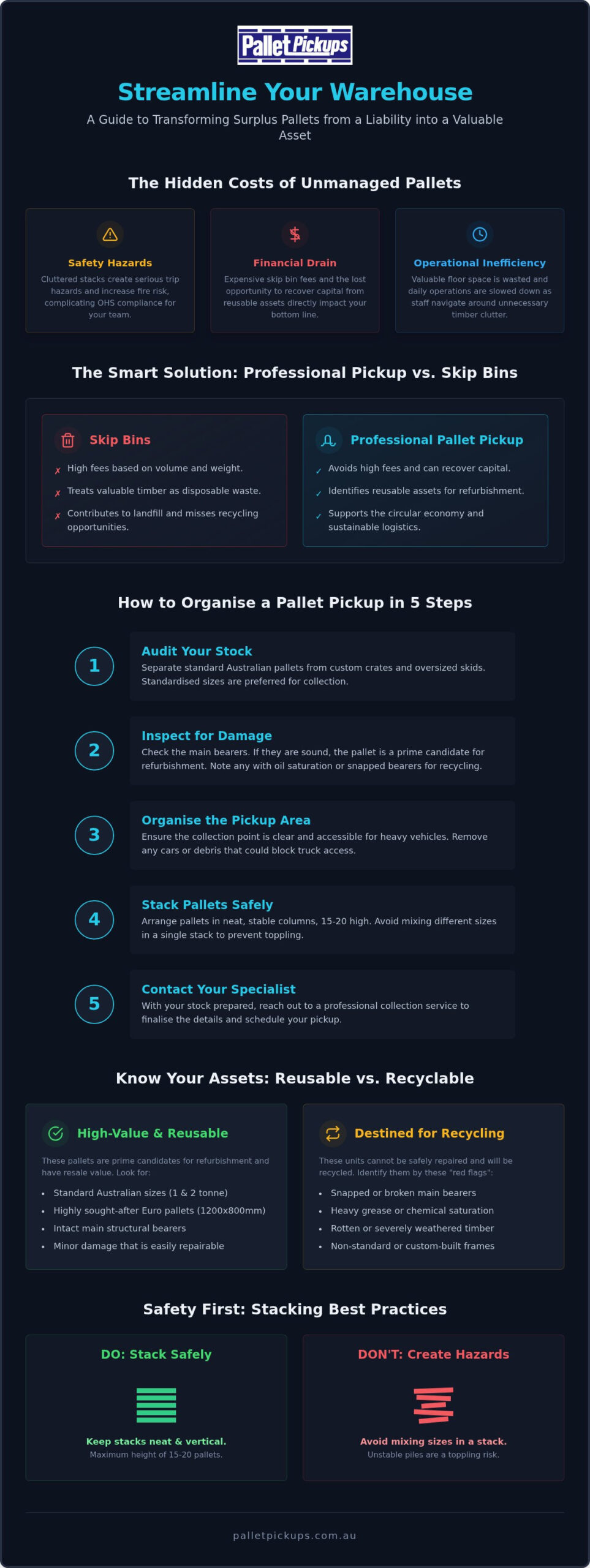
How to Organise a Pallet Pickup in 5 Steps
Organising a pallet pickup for businesses doesn’t have to be a logistical nightmare. By following a structured approach, you ensure your yard remains safe and your collection is handled without delay. It’s about preparation and clear communication with your service provider.
- Step 1: Audit your stock. Walk through your yard and separate standard Australian pallets from custom crates, oversized skids, or timber frames. Collection services generally prefer standardised sizes.
- Step 2: Inspect for damage. Check the main bearers. If the structural bones are sound, the pallet is a prime candidate for refurbishment. Units with oil saturation or snapped bearers are usually destined for recycling.
- Step 3: Organise the pickup area. Ensure the collection point is accessible for heavy vehicles. Clear any staff cars or loose debris that might block a truck’s turning circle.
- Step 4: Stack pallets safely. Arrange your pallets in neat, vertical columns. Avoid mixing sizes within a single stack, as this creates instability.
- Step 5: Contact your specialist. Once your stock is ready, reach out to a professional 2nd hand pallet collection service to finalise the details.
Sorting Your Pallets for Maximum Value
Not all timber units are created equal. A standard 1 tonne pallet is easily recognisable by its dimensions and board thickness, but you might also have heavy-duty 2 tonne variants mixed in. If your business handles international freight, keep an eye out for Euro pallets. These 1200mm x 800mm units are highly sought after for specific export chains. Separating these beforehand helps your collection partner assess the value of your load quickly.
Safe Stacking Requirements for Transport
Safety is the top priority during any pallet pickup for businesses. We recommend keeping stacks between 15 and 20 pallets high. Anything taller becomes top-heavy and risks toppling during the loading process. For maximum stability, use a neat vertical stacking method. This ensures the driver can secure the load efficiently and safely for the journey back to the refurbishment centre. If you’re unsure about your current stack stability, you can always request advice from our team during your initial booking.
Identifying Reusable Assets vs. Timber Waste
Determining the value of your timber stock is a critical part of a successful pallet pickup for businesses. Not every piece of wood in your yard is destined for the chipper. A “repairable” pallet is defined primarily by the condition of its bearers. If the three main structural lengths are intact, we can usually replace broken top or bottom boards to bring the unit back to industry standards. This refurbishment process is the heart of a sustainable supply chain.
There are specific “red flags” that immediately turn a potential asset into timber waste. We cannot refurbish pallets saturated with grease, oil, or unidentifiable chemical spills due to cross-contamination risks. Similarly, if the main bearers are snapped or have significant “missing chunks” from forklift damage, the unit loses its structural integrity. These pallets are typically rejected for refurbishment and sent for wood recycling instead.
You must also identify “Pool Pallets” before booking your collection. Distinctive blue CHEP pallets and red Loscam pallets are hire equipment and remain the property of those respective companies. Private collectors are legally unable to pick these up as part of a standard service. You should stack these separately and contact the pooling provider directly to manage their return and avoid ongoing hire fees.
The Value of Refurbished Racking Pallets
Heavy-duty 2 tonne racking pallets are among the most valuable assets in the second-hand market. Because these units are designed to sit safely in high-rise warehouse racking, they must meet strict safety standards. To be deemed “racking grade,” a pallet must have zero structural defects in the bearers and consistent board thickness. Their durability makes them a high-priority item for any business looking to recover costs during a yard clear-out.
Pallet Buy-Back vs. Free Collection
Your surplus timber could actually be a source of revenue. Many companies participate in a pallet buy-back program to offset their logistics costs. Generally, to qualify for a buy-back rather than a simple free collection, you need a minimum quantity of standard-sized, high-quality units. If your stock is mostly non-standard sizes or custom crates, it may not have resale value, but a professional service can still help you avoid the high cost of general waste bins.
Ready to clear your yard and see if your pallets qualify for a buy-back? You can book a professional pallet pickup for businesses today to get your warehouse back in order.
Optimising Your Long-Term Pallet Management
A reactive approach to yard clearing often leads to the very safety hazards and space issues we’ve discussed. By establishing a recurring pallet pickup for businesses, you transform a messy chore into a predictable logistics routine. Setting a monthly or fortnightly schedule prevents timber buildup before it becomes unmanageable. Many successful facilities adopt a “one-in, one-out” policy, where for every batch of new stock arriving, an equivalent volume of surplus timber is prepared for collection. This keeps your footprint consistent and your operational flow uninterrupted.
Consistent management also provides a clear advantage for your company’s ESG reporting. Choosing a partner that prioritises 2nd hand pallet collection and refurbishment allows you to report on tangible waste reduction metrics. It demonstrates a commitment to the circular economy by keeping transport assets in use rather than sending them to landfill. When choosing a partner, look for a local specialist who understands the specific demands of the Australian logistics landscape and provides reliable, timely service that matches your warehouse pace.
Integrating Collection into Your Weekly Workflow
Success starts with clear internal processes. Train your floor staff to sort pallets as they are emptied, rather than waiting for a massive pile to accumulate. Designating a permanent “Pickup Zone” near your loading dock or yard entrance ensures your collection partner has immediate, clear access. This zone should be clearly marked and kept free of other equipment. When your team knows exactly where the 1 tonne pallets or export units belong, the entire organisation becomes more efficient.
The Future of Sustainable Logistics
Widespread pallet recycling and professional refurbishment are expected to significantly reduce the industry’s reliance on virgin timber harvesting by 2026. Choosing a professional pallet pickup for businesses is the most cost-effective way to manage your timber footprint while supporting a more resilient, local supply chain. It’s a simple change that delivers long-term value for both your bottom line and the environment.
Reclaim Your Warehouse Space Today
Managing your yard doesn’t have to be a constant struggle against rising timber stacks. By implementing a clear sorting process and understanding the value of your 1 tonne and 2 tonne units, you turn a disposal problem into a streamlined asset recovery strategy. It’s about moving away from expensive skip bins and towards a circular model that keeps quality timber in the supply chain for longer.
A reliable pallet pickup for businesses ensures your site stays clear, safe, and compliant with OHS standards. Since 2017, we’ve been helping Australian companies manage their surplus through expert timber recycling and professional refurbishment of standard units. With a reliable national collection network, we make it easy to maintain a tidy facility while recovering costs through our dedicated buy-back programs.
Organise your pallet pickup with Pallet Pickups today to reclaim your warehouse space and start your journey towards more sustainable logistics.
Frequently Asked Questions
Do businesses have to pay for pallet collection?
Collection costs depend on the quality and volume of your timber transport assets. High-quality standard units often qualify for a free service or even a buy-back program, while smaller loads or non-standard scrap may require a service fee to cover the transport logistics. We recommend a quick site audit to determine the most cost-effective path for your specific yard.
Can you pick up broken or damaged wooden pallets?
We can collect broken pallets as long as they aren’t beyond the point of repair. If the main bearers are structurally sound, we can refurbish the unit by replacing damaged boards. However, timber that is snapped, rotted, or heavily contaminated with oil is usually destined for a recycling centre rather than our refurbishment line.
Why won’t pallet companies take blue or red painted pallets?
Blue and red pallets are proprietary hire equipment owned by CHEP and Loscam. Private collectors aren’t legally permitted to trade, refurbish, or dispose of these units as they remain the property of the hire company. You should stack these separately and contact the provider directly to arrange a return and stop your ongoing rental charges.
What is the minimum number of pallets required for a pickup?
Organising a pallet pickup for businesses is most efficient when you have a substantial load ready for transport. We typically require a minimum of 50 standard units to make the collection run logistically viable for our vehicles. If you have a smaller volume, it’s often worth waiting until you’ve reached this threshold to ensure a smoother service.
How do I know if my pallets are Australian Standard size?
Standard Australian pallets are easily identified by their square footprint, measuring exactly 1165mm by 1165mm. This specific size is the industry benchmark for compatibility with local racking and rail transport systems. If you measure your units and find they are rectangular, such as 1200mm by 800mm, you are likely holding Euro pallets instead.